
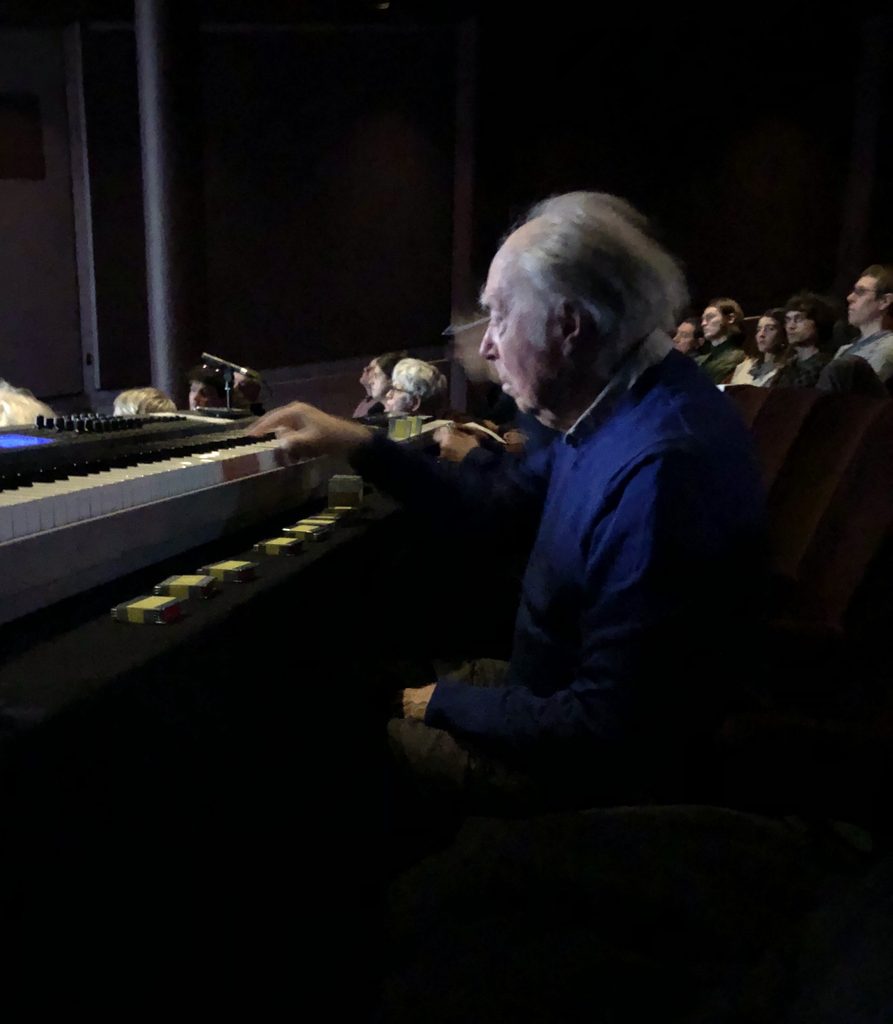
Michael Snow conversation with Elisabetta Fabrizi and Chris Meigh
Andrews. BFI Southbank, 6th of December, 2008.
Elisabetta Fabrizi:
I want to start with the film “Side, Seat, Paintings, Slides, Sound Film”, (1970), because it summarises a lot of issues of your work. You have been celebrated for your film work, but perhaps not everybody knows that you have had a parallel, and as important a career, in the visual arts. What were your reasons for starting to use film, and what did you feel as an artist that film could give you?
Michael Snow:
I started playing music when I was in high school, and I started to play more or less professionally, jazz and stuff like that. But for some reason, I was given the art prize in high school, and so it seemed to me I should study art. I went to the Ontario College of Art and Design and became interested in painting. To make a long story short, I went to Europe with $300 on one of those “trying to find oneself” trips. I hitchhiked around. I was almost a year in Europe on that $300, I played in bands occasionally, but I also did a lot of drawing.
When I came back to Toronto, I had an exhibition of these drawings, and received what turned out to be a very important phone call in my life. This man who I didn’t know, said he’d seen the exhibition. He liked it very much, and he thought that whoever had done those drawings was someone who was interested in the movies. I had to say that I wasn’t in particular- that my interest was jazz and painting and sculpture. He said, Well, I’d still like to
meet you. So I met him, and it turned out that he had a film company that specialised in animation, and he asked if I wanted a job. I really did want a job. I was trying to find a way to make ends meet, and here was a job where I
learned animation. He hired people who were fine art drafts people, not people who had necessarily an advertising background, because he thought of animation as a fine art. So we were doing commercials of different kinds for beer and whatever. But he was really inspiring, and he said that if we wanted to do something on our own, and the animation camera was free, and the cameraman was free, we could also do things for our own. After I’d been there a while, I made my first film “A to Z”, 1956, which is an animation. The company eventually collapsed because of hiring people like me. This man turned up in England. His name is George Dunning. He was the director of the Beatles film “Yellow Submarine”, (1968). When I saw it, I recognised
some things that I knew he’d been working on that he’d shown us. So in answer to your question, this is how I got involved with film. I heard things in music that really moved me. And I wanted to do something like that
and the same thing in painting. It was definitely a reaction, and the desire to find out how to do some things like that in my own way. But I didn’t have that at all with film. I was introduced to it by seeing what it is as technology:
because we were doing animation, and how the whole thing is made of one frame after another, and how you can alter what happens between the frame. I became interested in it from the point of view.
MS:
I made the film just the way I would make a painting and sculpture. I thought that maybe somebody would look at it at graphic films where I was working, but I didn’t think of having any kind of public show. I just wanted to make a film.
CMA:
So that would be quite distinct from painting, where you were clear you were making paintings that would be shown in the painting context.
MS:
No, it’s similar. Because I didn’t know what to do with the paintings, either! I’d like to say a little bit more about “Side, Seat, Painting, Slides, Sound Film”. The intention is that you really can’t judgementally see the paintings. Even if it was a slideshow, the voice says it’s 4 feet by something or other. So, with each one of them, there’s this juggle between what you’re seeing or actually hardly seeing at all… But the point of it, really, is to see the film. It’s not to see the painting or the slide. In the sense of seeing them in any in depth way, they were used to make a movie which uses slowing down and speeding up, and certain things that are only possible with this medium. But it’s interesting in that it’s one media meeting another medium. I did this in 1970, and since then, we’ve seen a lot of mediums eating mediums. So it’s very pertinent in that way.
EF:
In relation to “Wavelength” (1967), a seminal work. There’s been a lot written about the technique behind it, in the gels and the filters that you’ve used. It seems to me that there’s a sensibility which is very painterly.
MS:
Before I made “Wavelength”, which was shot in ’66, finished in ’67, I made a number of sculptures that used transparencies, gels, and it was partly because of this thinking about film, that I used them. I used it in “Wavelength” in the spirit of adding another transparency, through which light went. Sometimes they were filters, and sometimes there were sheets of plastic or gels. But I had already worked with them to a certain extent before I made “Wavelength”.
CMA:
I was thinking about “Wavelength” in terms of duration. Something you said connects to this business of working with sculpture, and then moving to film, and then going to painting and so on. You were talking about an equivalence, and you were saying that, for you, you were saying that for you, duration was the equivalent of mass in sculpture. I wonder if that’s something that’s common when you move from one medium to another, if you’re looking at the equivalence between things,
MS:
Not really. It’s specifically to do with the “La Region Centrale” (1971), which is three hours long, which, in certain circumstances, is a long time. I wanted to stress that, as one of the things one has a kind of material in making films, which can be equivalent of, as equivalent to weight in sculpture, especially in relation to “La Region Centrale”. I emphasise that because other uses of duration might call for another metaphor or simile. I think this is particular.
CMA:
It’s just that for a lot of people, even 45 minutes could seem like something
substantial. It does trigger certain kinds of responses. And so I’m wondering if
there’s a sculptural sensibility at work there when you’re using time.
MS:
With “Wavelength”, one of the sculptural equivalents was that I wanted to make shapes over a period of time in the spectator’s mind, and that shape is the shape of the projection beam. I think it does happen because when you move through it, the past is back there and the future is here. I believe that art is made by the phenomenon that you’re in. Maybe some people don’t agree, but that was one of the reasons for making “wavelength”, because- and this is odd, in a way, because I’m involved in completely improvised music. I felt opposed to a certain shapelessness that some films had, and they were involved in a kind of collecting of passages. This arrangement didn’t necessarily matter that much, and the total shape didn’t matter that much. with a narrative film, you can have a shape in mind, and that will be the passages that you go through on experiencing the story, but I have never been interested in telling stories, except for short stories. It’s about shape, making a shape in time.
EF:
Would you like to tell us how Jonas Mekas came to your help?
MS:
Between 1961 and 1967, all the work that I did used a Walking Woman, this cutout shape, or silhouette shape, in everything that I did, in many different mediums. I was just coming out of that into a new stage in my work and that was exemplified by “Wavelength”. So it did have an importance, even before it was seen by anyone. I was living in New York, and there were experimental film screenings. The most important ones were organised by Jonas Mekas. It was called The Filmmakers Cinematheque: He would rent a particular theatre, and these screenings would take place there for a few months, and then they might be somewhere else. So when I made ”Wavelength”, I thought that’s where I would show it. I didn’t have any particular ambition to show it elsewhere,
because I thought that the only places that anyone would look at these things were in New York, at the Museum of Modern Art sometimes, and there were two or three others. But I really didn’t have any idea that there was anybody anywhere else in the world. And about 20 core people came to the screenings. So at the most, it might be five or something like that. When I had finished the film, I thought I’d like to show it to certain friends of mine: They might dig this. I started by asking Jonas if one of these theatres was available one night, if it wasn’t being used for other screenings. So the first showing of it was to a bunch of friends. They liked it a lot, and Jonas said: “There’s a festival coming up in Europe, and I think you should send this film there”. When I made this film originally, there were different levels of sound. One of them is the street sound, and there’s other staged sounds, such as the breaking in of the man that dies, and the phone calls. That’s one level of
sound that I had mixed on one tape. But the sound, which is 40 minutes long, I recorded on quarter inch tape, and I thought, I would like to play it. So that each time it was played, I could do something different with it, or I would at least have control over what it sounded like in a particular space. I thought that if this film was ever shown again, I’d be there. So I could play this quarter inch tape. Then I realised that probably someone else would do it, and it wouldn’t do it right at all. So I said to Jonas. “That sounds interesting, but I think I can make a new track”, which seemed a bit dotty, because I was really poor at that time. And he said, “Okay, I’ll pay for it. He was super poor at the time, so it was an amazing gesture. It was sent to the film festival in Knokke le-Zoute, in Belgium, and it won the Grand Prix, which was $5,000. That was quite a lot of money, and it changed things quite a bit.
EF:
After that point, film and other filmmakers inspired you. So when you moved to New York, your experimental film knowledge came from what Jonas was doing.
MS:
I really didn’t know that there was such a genre or an area of film, and it was being in New York that introduced me to it. I was married to Joyce Weiland at the time, a wonderful filmmaker and a very good artist. We started going to lots of screenings and getting involved and meeting other people. Going to these screenings were various other people who we gradually found we shared some attitudes with. So, it was definitely a case of going from the provinces to the capital, because that’s where there were a lot of strong things being done, and it was something that made it possible for me to think, I favour that. I don’t like this. I want to do it that way. It was a very interesting scene, but it was mostly very separate from the art world.
CMA:
Did that include looking back at any other traditions in avant-garde film? Was there an awareness of that in the group, and an interest in that, that you connected to? Or was it really very much of the moment?
MS:
It was of the moment in the sense that it was a flowering of a bunch of varied talent. Maya Deren was someone who did work that was provocative, and who opened up different ways of doing things for a lot of people. Stan Brakage, for example, would relate to her films as to a kind of awakening. And there was a lot of that kind of thing. I was going to say that the only time there was any art world connection at these screenings that Jonas put on was when Warhol showed.
CMA:
So there were a number of different camps even within the filmmaking world,
MS:
Warhol brought a gang with him, and it was the fashionable gang of the time. But these people were never there at other screenings, like Hollis Frampton or even Jack Smith, for that matter. Should I tell another story? It’s about “New York Eye and Ear Control. It was done in 1964, I think. So in ’64, ’65, was its first screening in New York. It was on a programme with a work in progress by Andy Warhol. It had a title of some kind, but it was in process. So all these people came. My film is 32 minutes long, and these people hated it. They threw stuff at the screen and booed and hissed, truly incredible! But the thing that’s really fabulous is, when Eye and Ear Control was finished, Warhol and Gerald Malanga ran back to the projection booth very excited and said, “Who did that? This is amazing. It’s wonderful.” So their feelings didn’t coincide with the gang.
EF:
In a documentary about Richard Serra, he was asked about his beginnings in New York, and the people there, he talked about several visual artists, and then he mentioned Michael Snow. Is there anyone from that world making work who was inspirational to you? MS. When I first saw Richard Serra’s work, I was really impressed. I think
he’s a wonderful artist. I don’t know whether there’s any influence in that way. I don’t think so, really. I was making quite a lot of sculpture at the time, but it’s work that has some relationship to the camera. These are sculptures that are involved in directing one’s attention. One of them is called “Scope”, (1967), and it’s a great big stainless steel periscope. There’s another one called “Blind”, (1970). It’s a bit like a fading out or focussing on different planes. So I was very influenced by the camera, but they didn’t have anything to do with anything that Richard was doing. After ”Wavelength” was shown for the first time in New York, I got a letter from Steve Reich, who I didn’t know at the time. And it was just that he was so knocked out with the film that when he got home, he wrote about it, and then he decided to share that with me. We became pretty close friends, because my studio, where I shot “Wavelength”, was on 300 Canal Street, which is off Broadway, and he was just up the street on Broadway.
CMA:
What date are we talking? 66- 67?
MS:
No, 68, I guess. 67 or 68.
CMA:
At that time, he (Reich) was working with tape loops- presumably, and starting to experiment with phasing. And there was clearly stuff like that going on in “Wavelength”, and presumably that’s why he was so enthusiastic.
MS:
At that time, I hadn’t heard anything of his, but people were already working with loops, so it was in the air.
CMA:
You were also having conversations with Hollis Frampton about ideas about art. Did you have those kinds of discussions with Steve Reich too? Did you have exchanges?
MS:
Maybe more with Richard Serra, although he astounded me, and I still feel astounded. We would be in a bar, and he would talk about his work and say, “I’m going to do this. I’m going to put this up against this, and that against that. What do you think of it?” He wanted me to comment on this, and I thought it was really amazing. He actually asked me over to his studio to look at stuff and talk about it, which I thought was amazing too.
EF:
You said that “Back and Forth”, (1969), was very important, because it was a sketch.
MS:
Yes, I got interested in it trying to do something with painting in the way I’d done something with zooming in w”Wavelength”. So, this was just trying out things. It’s a home movie. It’s quite short. It’s only 11 minutes, I think. But one thing about it that I’m proud of is the soundtrack. It’s me playing the radio, and it’s done totally separately. And since then, I’ve used playing the radio in “Rameau’s Nephew by Diderot, (Thanx to Dennis Young) by Wilma Schoen”. have also put out some recordings. There was a cassette, and it’s coming out as a CD as well, called “Two Radio Solos”, which is playing a short wave radio.
CMA:
You talked earlier about one medium eating another. The work in the foyer- (“Sheep Loop”) are all digital, and given what you’ve said in the past, about using mediums for what they can do. I’m interested in where that puts you in relation to the digital, as a proposition, as a way of working, as a tool, to feel there is something particular about the digital that you find effective, or maybe even the opposite, destructive in some way.
MS:
I spent almost 20 years making a film called “Corpus Callosum”, (2002), which is a 90 minute film shot on digital video cam. It was intended to use computer modifications, alterations, transformations, using a software program called Houdini, that was developed in Toronto. The main creator of that program worked on this film with me, and it came about because in 1981, I finished a film called “Presents”, (1981), which has two or three main sections. In the beginning, I wanted to find a way to compress and stretch the image. It’s a film that was going to be shown in 16 millimetres, so I tried using prisms and things like that. And then, watching television, which happens to be fairly rare with me, I saw a wipe, a way of changing scenes that squeezed, and then stretched out, which was exactly what I wanted to do. I looked into it and found out that it’s a Quantel system. So, using this system, I did what I had intended, which is squashing the image and then stretching it out again. That was only part of making this film, but it really intrigued me, and I started making notes and thinking about making a film that would be just about squeezing and stretching. I was thinking of just using that apparatus. But as a few years went by, with occasional notes on that, and other things, I started noticing some of the possibilities that were emerging using computer animation. And gradually, I thought about going further, rather than only stretching and squeezing, doing some other things, too. And the technology kept on changing. It happened fairly fast. By 1990, I had particular ideas of making a certain transformation. It could be done. But it would take 50 hours
of computer time and cost $50 million. In the 90s, everything started to change. The technology in a kind of acceleration. And I was following that. Then I played a concert, in the intermission, I was talking to somebody from the audience, and it turned out to be Greg Hermanovic, who was the designer of this program. I mentioned these ideas that I’d been thinking about for at least 10 years, and he knew my films, and said he really like to talk more about it. He got involved and decided to try to shoot some of it, and I was lucky enough to get a grant. But our budget estimates were completely crazy, and we used up the money to shoot three seconds of something or other. And that happened for a number of years. I’d get something done, and then it’d have to stop and try to find some more money to do it. Because it was expensive, but it gradually got done. At one stage, I decided it was probably going to be impossible to do this 90 minute thing, which was all completely written out, it was a prior composition. I looked over what I had accomplished, and one part of it was one of the scenes in the living room, called “The Living Room”, (2000), and I issued that, finished it, and showed it separately, because at the time, I was convinced that I’d never be able to do the whole thing, and this works very well by itself. Then, with wonderful luck, I met somebody who knew how to ask the right people with the right language for money, and so I was able to get enough money to finish it. But the point of doing it was to use the malleability that a digital image has, something that could never be done before. And my background was in animation, and the other thing that was fantastic was that you could use real live action shooting and modify it, which, in the past, was also extremely difficult.
EF:
But the film is staged. It’s got actors and a plot.
MS:
Yes, the film is thoroughly staged.